
Satire: The Sarcastic Vehicle for Futurists
“I have been assured by a very knowing American of my acquaintance in London, that a young healthy child well nursed, is, at a year old, a most delicious nourishing and wholesome food, whether stewed, roasted, baked, or boiled; and I make no doubt that it will equally serve in a fricassee, or a ragoust.” – Jonathan Swift, A Modest Proposal[1]
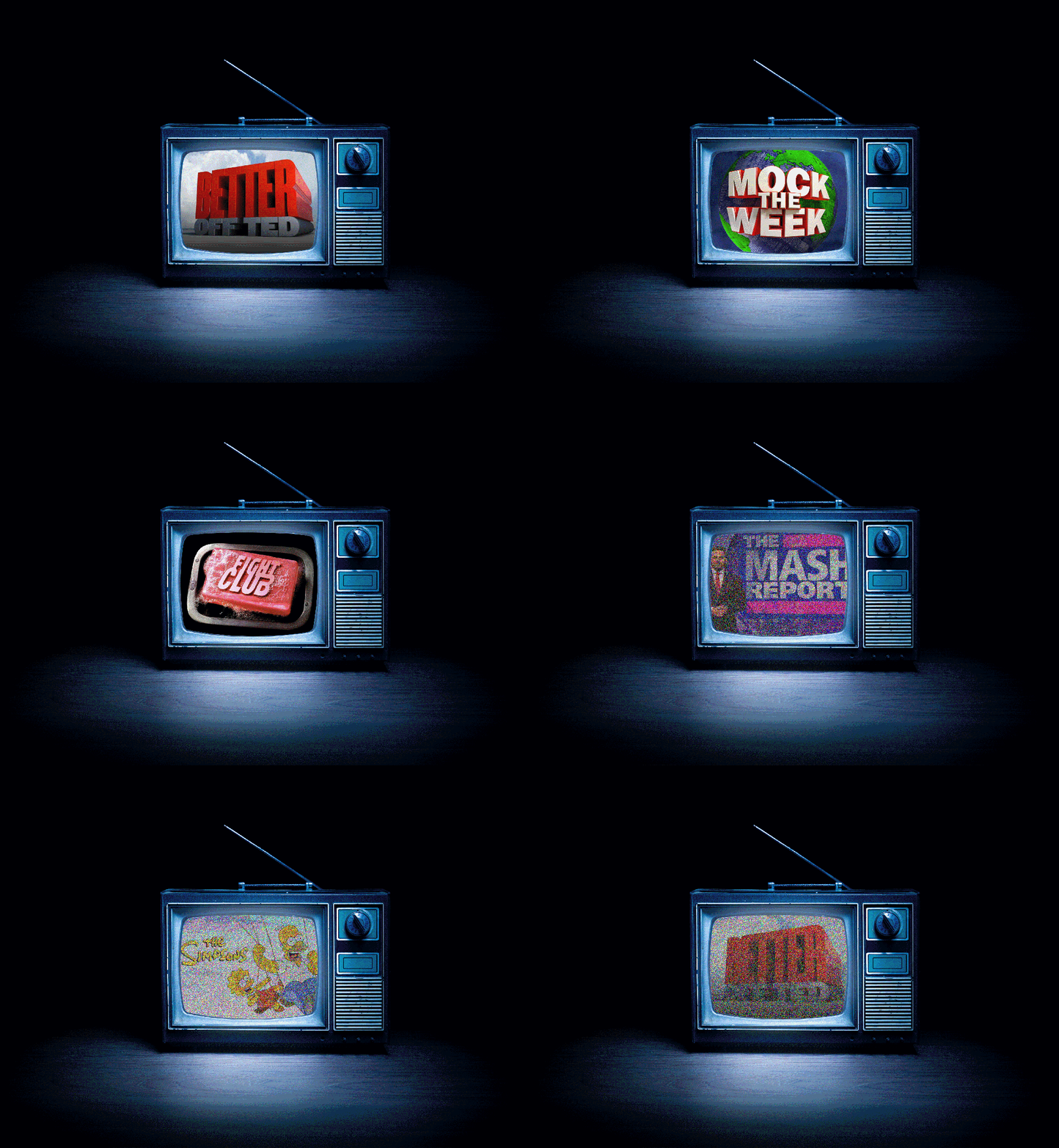
While many of us during the COVID-19 pandemic have spent time in quarantine watching true crime documentaries, baking shows, and copious amounts of Disney+ programming, I have been drawn to British satirical panel shows such as “Mock the Week” and “The Mash Report” (RIP)[2]. While these shows poke fun at the current state of the world, I’ve noticed that the panelists, whether intentionally or not, sometimes say things that soon went on to be reality. Of course, this is only apparent in retrospect, but at the same time, the nature of satire allows pushing of the absurd to a level unable to be achieved by other media.
Satire is a genre of media that intentionally takes sharp jabs at an entity to force change (sounds familiar to all my futurists, right?). Its combination of humor, wit, and social criticism, along with elements of exaggeration, comparison, and irony, allow the performer to construe elements of today with other elements that would not be tolerated in rational discourse. Popular examples of this include Jonathan Swift’s A Modest Proposal, Rob Reiner’s This Is Spinal Tap, and Trey Parker and Matt Stone’s South Park. Many other examples, ranging in the level of “bite” in their assessment of a contemporary issue, can be classified in in three types:
- Horatian Satire: a gentle form of satire that ridicules and parodies dominant attitudes or lifestyles. Named after Roman satirist Horace, it seeks to teach with a smile rather than a frown[3].
- Juvenalian Satire: an abrasive form of satire that takes pot shots at specific entities, using pessimistic ridicule to force change. Named after Roman satirist Juvenal, most political satire can be lumped as Juvenalian, particularly if it’s seen as polarizing[4].
- Menippean Satire: a form of satire, mostly seen in prose, that often mixes the contemporary with the fantastical, and addresses general thought process and conventions of a civilization. Named after Greek satirist Menippus, this form of satire is highly stylized, with people acting as the personifications of specific thoughts or beliefs[5].
Now that we have the academic stuff out of the way, the point is that satire has been embraced by the public at large, even if it’s not recognized as such, or worse, seen as only a political tool. A favorite show of mine is a satirical comedy about large company culture called Better Off Ted (RIP)[6]. The show features Ted, the head of a research and development department in the fictional company Viridian Dynamics. Viridian takes the idea of a soulless corporation to an extreme level (the first episode, for example, has the higher-ups at the company deciding that they want to freeze one of their scientists, just to see if it can be done). Viridian is a force to be reckoned with, having swayed elections, created killer vegetables and animal-hybrids, and has made themselves a force stronger than most governments in the world (as character Veronica said, “…the company never parts with [money] unless forced to by a government stronger than they are. And there’s only three of those left”). When it originally aired, many of us probably thought that no company could become that big and powerful, and especially not that…evil. But as we look back, we can see that the creators of the series predicted many things:
- A company’s ability to sway the government and the public through political manipulation and rigidly controlled supply chains, both physical and digital[7].
- Companies limiting and rescinding several key benefits, promising to not use threats and intimidation (as Ted puts it, “Remember ‘Whee, Pension Rollbacks?”)[8].
- Partner-matching created through genetic matches versus the age-old process of getting to know someone[9].
The sheer fact that satire thrives on the idea of absurd uncertainties is why it is such an important tool for futurists and vital to helping change the minds of the public. With the above, we would think that these events would either not happen through “common sense” ethics, human decency, and the importance of privacy that extends to our DNA. Yet there is proof that these ideas have come to fruition.
Another example lies in the satirical animated series The Simpsons. Many people have marveled at how the show was able to predict many things, such as the presidency of Donald Trump, mutant tomatoes, and even Disney’s acquisition of Fox. While some things that The Simpsons supposedly predicted are now commonplace (such as autocorrect and smart watches), or have inspired real criminal activity (e.g., ferrets shaved to look like toy poodles or staff stealing grease from restaurants to sell), those activities are more closely linked to the influence pop culture and satire have on the world versus predicting something so seemingly absurd that it could never become reality[10]. Take Donald Trump’s presidency, for example: In the United States, we generally believe that there is a certain political path one takes to eventually get to the highest seat in the land. The idea that a “reality star” could win the office of the presidency without having served in the House or Senate seemed very unlikely at the time, and highlighted the idea that character Lisa would have a lot to do to clean up after a reality star was gone. The Simpsons reflected on how they predicted the future in a later episode’s chalkboard gag (“Being right sucks”), but simultaneously, they were able to use the skills learned from satire to at least give the idea of what could happen. It’s dependent on people to turn the what if into when.
By immersing oneself in satirical media, it becomes easier to not only think of what’s witty and sarcastic, but also what is seemingly unlikely but probable. Satire is meant to evoke change, whether that’s a change in attitude or a change in existing processes. But if something said or written satirically becomes reality, it’s also imperative that we understand why this change occurred. Going back to the Trump presidency, disillusionment with career politicians who are out of touch with their constituents and a ballooning budget deficit could be valid reasons why Trump was able to gain the traction he did. Understanding the why then leads to the creation of plans for if something like this were to happen again, or how to fix the current political process to be less disconnected between politicians and people.
There are many sources of satire in our entertainment libraries, and while any futurist worth their salt should read and watch as many news and academic sources as possible, there should be some time put aside for satirical work. After all, the more we say “that will never happen” with certainty, the more likely it will become fodder for satire – and then become our reality, whether we realize it consciously or not.
[1] https://www.gutenberg.org/files/1080/1080-h/1080-h.htm
[2] This show should NOT have been cancelled. I may be a bit bitter about this.
[3] https://www.nku.edu/~rkdrury/422/satire_terms.html
[4] https://www.britannica.com/art/Juvenalian-satire
[5] https://www.britannica.com/art/Menippean-satire
[6] Another show cancelled too soon. I’m very bitter about this. Watch it on Hulu.
[7] https://www.bloomberg.com/news/features/2021-02-09/this-is-how-tim-cook-transformed-apple-aapl-after-steve-jobs?utm_source=pocket-newtab
[8] https://www.nytimes.com/2021/03/16/technology/amazon-unions-virginia.html
[9] https://www.wired.com/story/with-this-dna-dating-app-you-swab-then-swipe-for-love/
[10] Tune in next time for an article about the responsibility creators have on influencing the world.
 formthefuture.org